
Legal teams everywhere are being asked to deliver more.
But headcount and budgets rarely grow at the same pace.
So how do legal teams respond without simply working longer hours?
That was the focus of Radiant Law’s recent webinar with Lorna Curry, a former General Counsel with more than 35 years of experience, including 20 years at GE. Now working as a consultant, Lorna helps organisations rethink how their legal teams operate and where their time really goes.
In conversation with Radiant’s Ian Teague, Lorna shared a practical way for legal teams to prioritise work, improve efficiency, and focus on the areas where legal adds the most value.
Here are some key insights from the discussion.
Legal teams often say they are overwhelmed by the volume of work.
But the real issue is often the mix.
A team might still be handling “contracts”, but the nature of those contracts may have changed. They may now be more complex, more bespoke, or more business-critical.
Without visibility into that change, it becomes difficult to explain why the team feels stretched or to make a compelling case for improving the operating model.
Understanding what work actually looks like today is the first step to improving how legal operates.
One of the most practical tools Lorna shared was the MoSCoW prioritisation framework, which divides work into four categories:
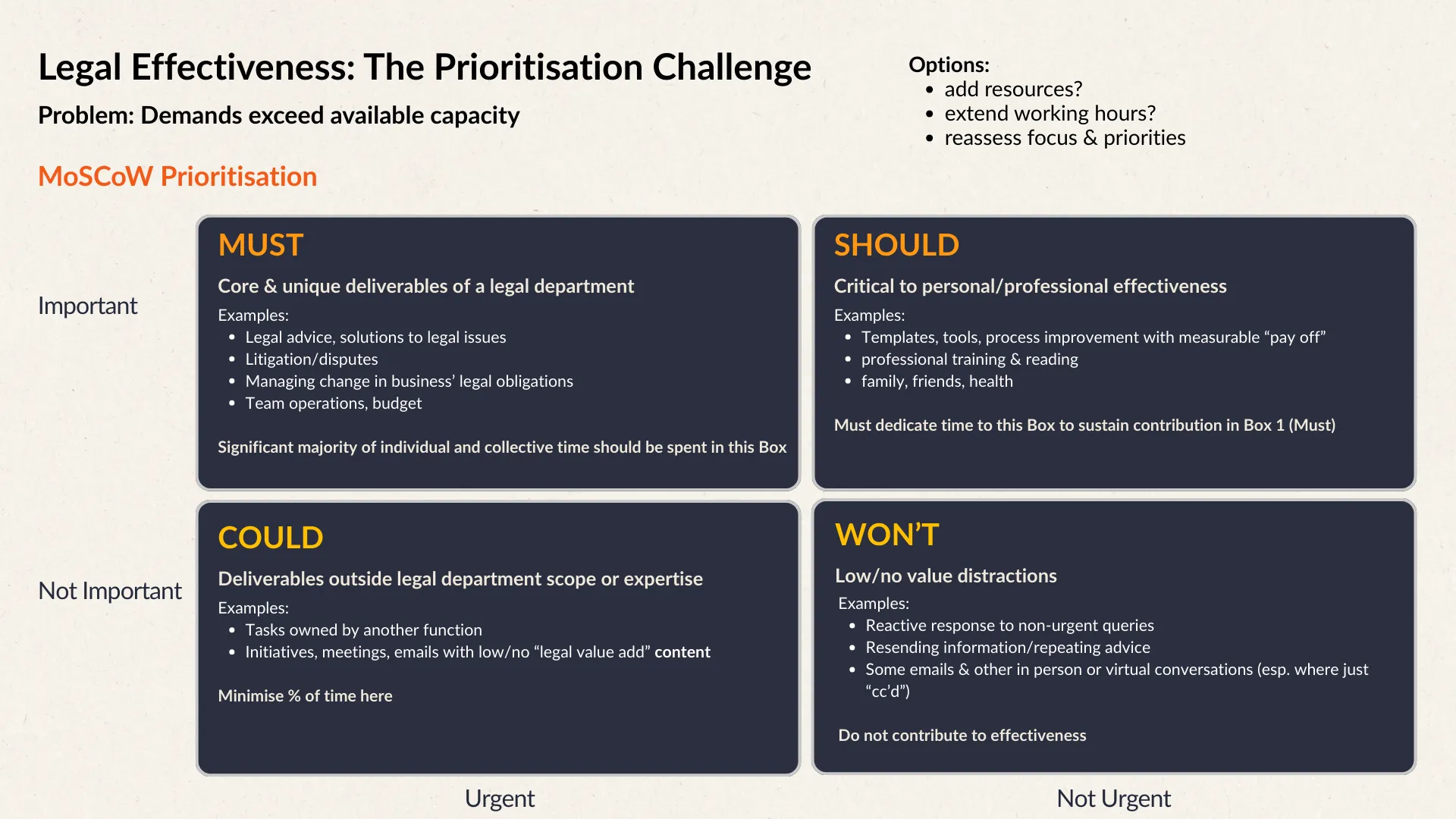
Must – the work where legal brings unique and essential value
Should – activities that keep the team effective and sustainable
Could – tasks that legal often helps with but may not need to own
Won’t – low-value activities the team should consciously stop doing
The goal is not to judge the work. It is to create clarity.
Because when everything feels urgent, legal teams often default to simply doing everything.
That is rarely sustainable.
Many lawyers assume their workload is dominated by critical legal tasks.
In reality, a surprising amount of time often sits in the “Could” category.
These might include:
Lawyers are naturally accountable professionals. If something might go wrong, they step in.
But over time that behaviour pulls legal away from its highest-value work.
Recognising the difference between important work and appropriate work for legal is key.
Lorna’s advice for teams starting this exercise was simple:
List everything you do.
Some teams track their activities for a couple of weeks. Others run workshops where everyone brings examples of the work they handle.
This inventory should include:
Once that work is visible, teams can start categorising it and having more productive conversations about where legal effort should really go.
A key theme in the webinar was that legal often operates in what Lorna described as a “data-free environment.”
Lawyers rely on instinct and experience to understand workload pressures. But instinct alone rarely supports operational improvement.
Legal teams benefit from asking simple questions such as:
Even basic tracking can reveal useful patterns.
Once those patterns are visible, it becomes much easier to improve processes, allocate resources more effectively, and have more meaningful conversations with the business.
The conversation also touched on AI and legal technology.
Lorna’s view was pragmatic.
AI can be powerful, but it cannot fix a problem that the team does not understand.
Before adopting new tools, legal teams still need to understand their workflows, risk parameters, and operational pain points.
When technology is introduced into a clear operating model, it can dramatically improve speed, consistency, and capacity.
But technology alone is not the starting point.
One of the strongest themes from the webinar was that better prioritisation is not just about efficiency.
It is also about creating a more sustainable way for legal teams to work.
When legal teams understand where they add the most value, they can:
And ultimately, that benefits everyone.
You might be wondering what your next steps should be. Let us guide you with three easy options:

We use cookies to monitor the performance of our website and to improve user experience. By continuing to browse our site, you agree to our use of cookies.