
Go Back

Running with the Machines (Redux)

“Did you ever notice that all machines are made for some reason?" he asked Isabelle. "They are built to make you laugh, like the mouse here, or to tell the time, like clocks, or to fill you with wonder like the automaton. Maybe that's why a broken machine always makes me a little sad, because it isn't able to do what it was made to do." Isabelle picked up the mouse, wound it again, and set it down. "Maybe it's the same with people," Hugo continued. "If you lose your purpose...it's like you're broken.” - Brian Selznick

I’ve written extensively about AI, but things have changed again since the last edition of the book in 2024. If nothing else, the certainty has grown amongst market observers that everything is changing and, this time, it really is different. Market observers are one thing, but the lesson I have learned is that law firms do not believe that this time is different.

How can this be, Alex? What about all the announcements and rollouts? One simple observation: the vast majority of legal services are still charged on the billable hour and its derivatives, while fixed fees account for only 5% of legal spend. Why would you try to incentivise your team with a million pounds if you really believed the immediate effect would be a crash in revenue and profit? Your first announcement would be that you had switched to fixed-price only.

It’s our old friend, innovation theatre. Luckily, we have the Tony/Olivier awards for law and the 50 best firms right now at innovation (theatre) are helpfully listed. Not one of them is mainly, let alone totally, fixed-price. Radiant Law remains an outlier 15 years after we started.

If you want to play along, at your next conference panel on AI (it shouldn’t be hard to find one), ask a law firm that has been enthusing about its AI initiative the simple question: how many billable hours has that initiative saved? I’ve only managed to get spluttering so far. Let me know if you get a number.

Meanwhile, outside the world of legal, studies are showing individuals getting remarkable personal productivity boosts (I can attest), but the impact is still not turning up in their employer’s productivity numbers:

“Overall, our findings challenge narratives of imminent labor market disruption from Generative AI. While we capture early impacts, two pieces of evidence suggest the limited labor market effects may persist in the foreseeable future. First, our dynamic difference-in-differences estimates remain flat throughout the two-year study period. Second, even among “AI front-runners”—workplaces that have adopted the full suite of proactive chatbot initiatives and workers who adopted early, use the tools daily, or report substantial benefits—the results remain null.”

We basically have arbitrage going on by employees who are understandably wary of being rewarded with more pie after figuring out how to eat it more efficiently. Inside law, we also have such artful constructions of incentives that law firms are confident that they can spend money on AI initiatives to “save time” and end up making more money while continuing to charge for time.  Perhaps one day we will have an honest discussion about the widespread dishonesty in practice of the billable hour system? There, I said it.

Anyway, it’s working for them - prizes are being won and law firm revenues are up in the UK and the US (mainly buoyed by rate increases, but hours are up in the US and only slightly down in the UK with no indication that this is caused by anything other than the economy).

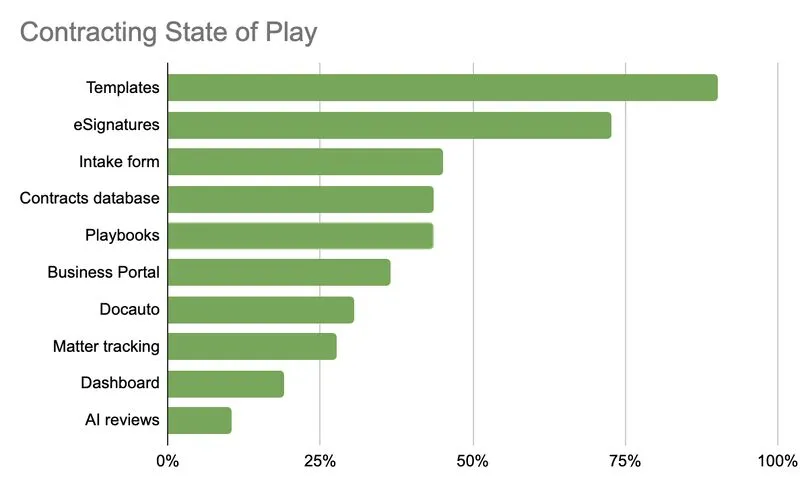
Clients are starting to complain and are talking about bringing more in-house if their law firms won’t blink, but consider where clients actually are with their contracting (recent responses to Radiant’s scorecard showing the proportion of companies that have implemented various tools, n=110):
Article content

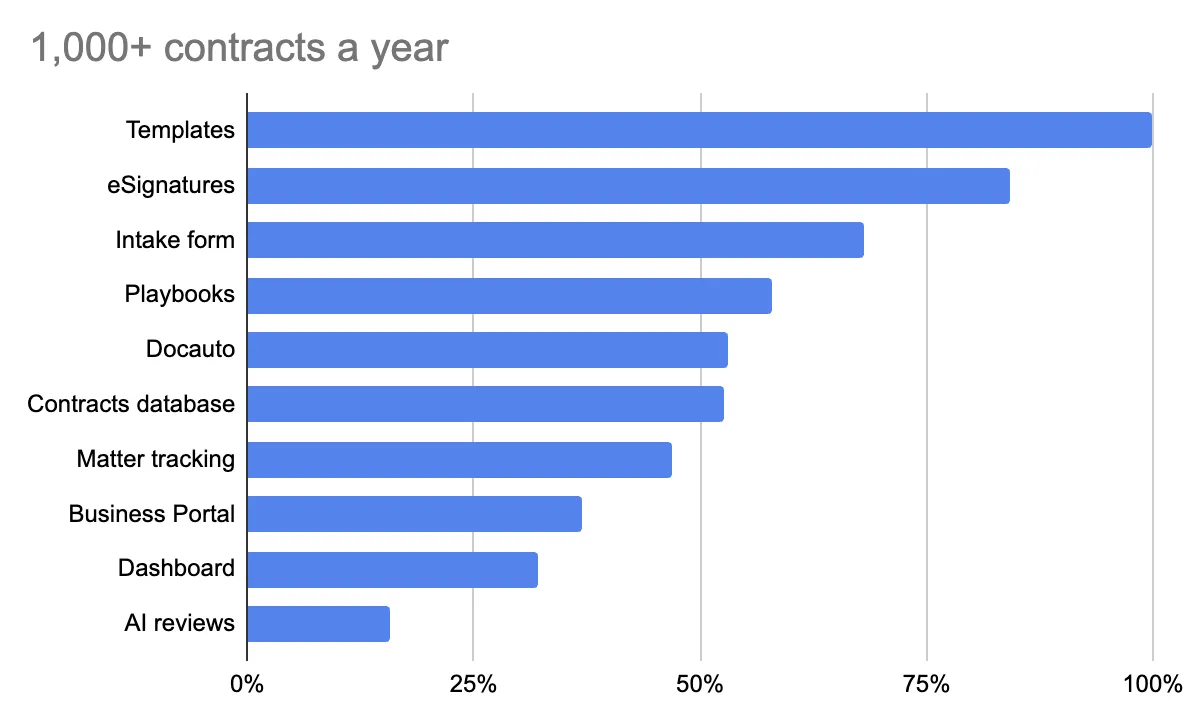
It’s not so much better for in-house teams supporting more than a thousand contracts a year (n=19):
Article content

Quite a difference to the breathless discussions at Legal Geek last week. I’m not sure that clients really believe that they can crash their cost of delivery by just buying an AI tool and stopping sending work to their law firms. If it’s really all about tools, then why haven’t clients done the basics that have been available for decades? I’m sure that some clients will implement AI brilliantly, and significantly reduce their external spending, but speaking on the conference circuit remains easier than building and, as everyone eventually learns, giving lawyers more tools does not automatically lead to higher productivity in-house either.

Meanwhile, one of the hottest stories is the emergence of “AI-first” law firms. There are a number of claimants for who is first amongst the “firsts”, but whoever it is, they are most welcome to the crown. Legal is not a serious industry, despite so many participants taking themselves so seriously. No serious industry would start, or be so obsessed, with tools. The serious ones start with purpose and clients’ needs; then principles and values, ideal results and ideal behaviours, systems (in the broad sense) and processes… and then they might discuss tools. I know some of the serious people: lots more humility (and fun), not much discussion of robots (despite often hanging out in manufacturing). But here we are.

GarfieldAI got much of the coverage in the UK (despite acknowledging that they were mostly doing document automation and workflow), but the real money is coming out of the US. The US is different. Yes there is the scale of the thinking and money, but there is also a background of ridiculous bills (average legal spend by enterprises far exceeds the rest of the world as a percentage of revenue), UPL thanks to the power of the guilds, and what seems to be a pervasive lack of interest in anything that isn’t technology and/or brand. In the US, “ALSP” generally equates to a “temporary talent agency”, and with some honourable exceptions, the industry has underinvested in knowledge management, processes or efficiency. In this context, lawyer-plus-AI might indeed be revolutionary, and a playbook turned into SQL can be breathlessly described as a company’s “legal brain”.

We have seen VC money meet New Law before with Clearspire and Atrium. “The hardest part of the business is the services part. Everyone is trying to build software to automate legal tasks, but the hard part is the services component.” said the founder of Atrium, Justin Kan, in retrospect. I guess we are going to have to learn the lessons again about the fundamental economic problem with the returns available from a captive-as-the-only-customer, after you’ve thrown SaaS-level funding at the tech side without understanding what will actually improve productivity. Clue: a sane process will be a better investment every time. Not my money, not my problem.

What is my problem is that the oxygen is being sucked out of the room by the hucksters. Radiant has taken a different road, focusing on purpose, behaviour, process, and systems thinking. We have spent 15 years building the fastest law firm on the planet, turning contracts in half a day, and striving to help our clients create better relationships, not just weaponise debates about indemnities. We are an aberration, and as such, best ignored by the commentators-at-large, because we undermine the narrative that the only solution is the latest hot topic.

But Radiant has to deal with the reality-as-we-find-it of this market, so I feel it’s necessary to explain what we are doing with AI and to start answering the question: how might you integrate AI if you believed this time is different?

I actually suspect that this time it really IS different. GenAI has reached the point where, despite not being inherently reliable, you can do such interesting things that just weren’t practicable before.  But like Toyota, in the face of robotics, we aren’t going to throw away what has already delivered world-class performance, nor diminish the role of humans in improving how things are done. We need to carefully integrate AI into how we work and identify opportunities for improvement, or the cost of great marketing will be worse outcomes for clients. So what do you get a firm for Christmas that has been fixed price-only from the beginning, and so has:

  • processes that reliably work,
  • its own proprietary tech stack (we don’t have any third-party legal tech in our environment apart from the open source Docassemble, because the tools out there either isolate data or can’t handle our unique ways of working),
  • deterministic tools that already halve the time to turn a contract,
  • a fully-integrated data layer (as in there is only one list for anything, and every data point connects to every other data point - can you name any other firm with one?), and
  • better data than anywhere else on what actually happens during the lifecycle of negotiating a contract?

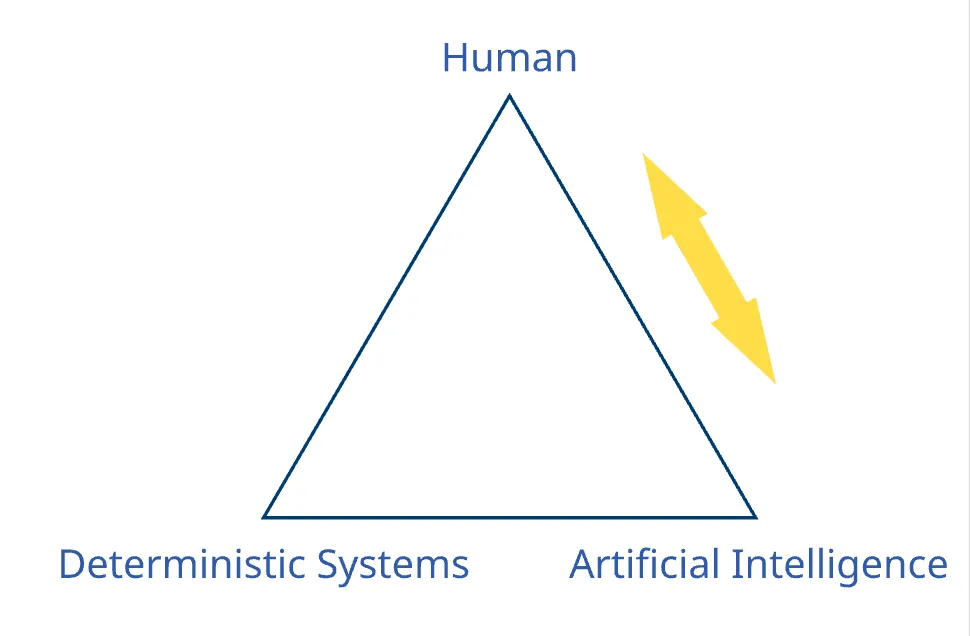
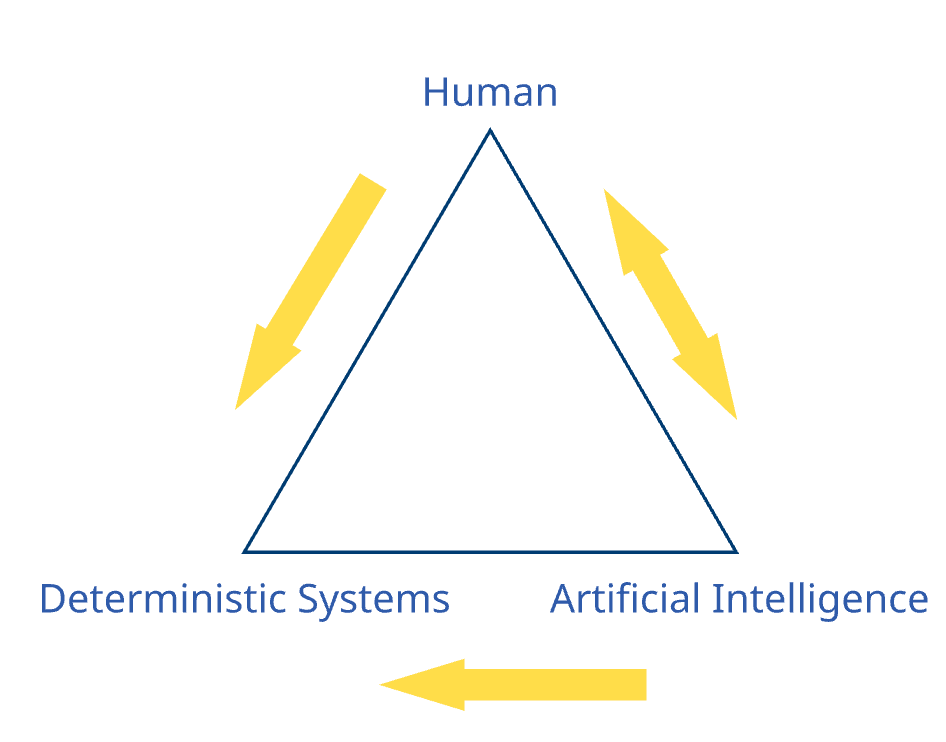
The starting point for us is to recognise that AI is different to deterministic tech (i.e., technology that gives you the same result for the same input) and that you need all three:

Article content

Most law firms, at least according to their announcements, have approached AI as a dance between humans and AI:
Article content

This is fundamentally what Harvey, Legora, Copilot, etc, are doing. It can be helpful, but it won’t show up much in your productivity figures because:

  1. It assumes that every task is different and reinforces uniqueness over similarity in work (remember, in legal, the tendency is to talk in terms of projects - which are assumed to be unique - rather than processes).
  2. Most importantly, it assumes that the most valuable resource is GPUs, but what is actually most precious is human concentration. If AI remains unreliable, everything has to be checked, and you are keeping your team in a permanent state of checking.

This approach is fine for the ad hoc, and we have given our team MS Copilot because, however many processes you have, life still has plenty of ad hoc tasks.  But this approach also glorifies the ad hoc, isolates systems, and by itself does not produce scalable and reliable results.  Tech suppliers are trying to address this (agents, workflows, MCP, RAG, etc), but you can’t get around the checking problem (if you don’t believe me, show me a contract where an AI legal tech supplier takes responsibility for the results). So that means we need to find a way to work with deterministic technology and tools, too, because they provide reliability and at least reduce the need for checking.

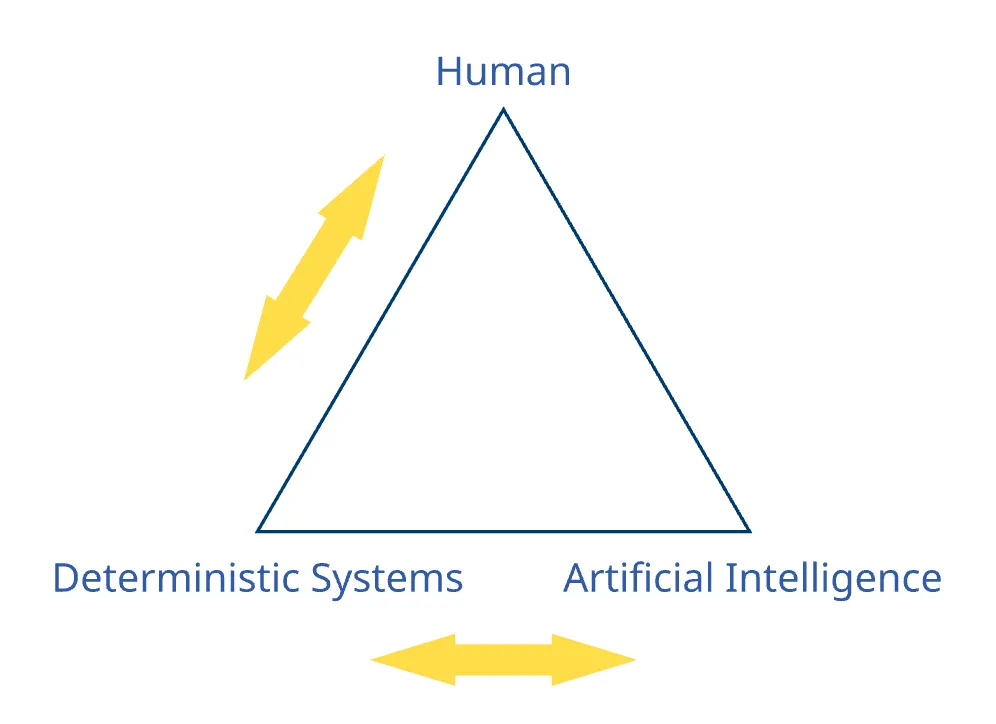
We are applying two more approaches to this conundrum. The first is to subsume AI beneath deterministic systems:
Article content

“Luckily”, we have built just the right technology stack to do this, with a unified front-end, an integrated data/deterministic layer, and now a modular underpinning of workflows that call AI where helpful. The first workflow for the new infrastructure was created this week, and we should have five up and running in the next fortnight. Because the tools and infrastructure are fully modular, our goal is to be able to add new tools in a day or two and have workflows benefit from improvements to common modules.

We aren’t sure which tools will add the most value, so we'll just build lots alongside our lawyers, and see which ones help in our perpetual quest for perfection.

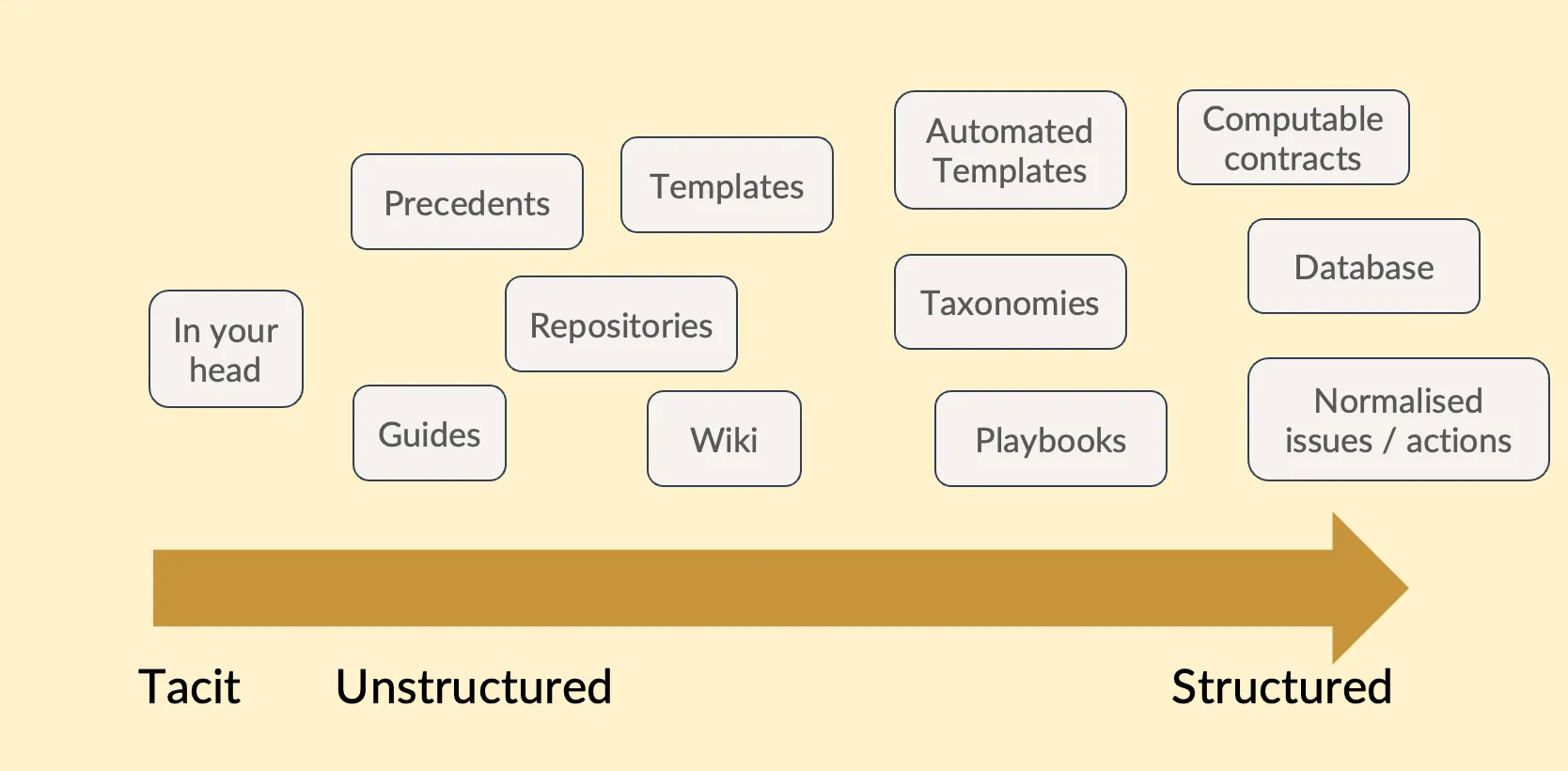
This approach works with SQL and deterministic system, but as I have described in a couple of recent talks, although you are trying to build more structure for your data over time, it is a journey and not everything can be collapsed into rows and columns:
Article content

This takes us to the third approach, running with AI (especially agentic AI) to improve assets such as automating templates, refining the wiki, updating playbooks etc. Is there a way to do this?:
Article content

Funnily enough, we recently hit milestones applying this type of approach, too. We have invented a new markdown language for contracts (Fineprint) and have built a series of converters that let us pull, from across our IT environment, more document-centric information (plus relevant database information) into text files. This allows a human plus agentic AI to make changes across all of them, before pushing the checked versions back to where they live. Last week, we demonstrated one-shot automating a complex document for Docassemble; this week, we demonstrated one-shot normalising multiple pages in our wiki.

I may have been a bit grumpy about AI initially, but what you can do now is extraordinary, and we are running like crazy with the machines. But we are doing it safely and in our own way: we are going to keep humans (despite their limited concentration) firmly in the driving seat, and we are going to continue to prioritise purpose over fitting into the latest narrative. Some things shouldn’t change.

Keep the momentum going! Here's what to do next:

You might be wondering what your next steps should be. Let us guide you with three easy options:

Take the Optimised Contracting Assessment
Start Quiz
Attend a Webinar
Register
Get Expert Support
Contact Us
Previous article
There is no previous article.
Next article
There is no next article.

Running with the Machines (Redux)

“Did you ever notice that all machines are made for some reason?" he asked Isabelle. "They are built to make you laugh, like the mouse here, or to tell the time, like clocks, or to fill you with wonder like the automaton. Maybe that's why a broken machine always makes me a little sad, because it isn't able to do what it was made to do." Isabelle picked up the mouse, wound it again, and set it down. "Maybe it's the same with people," Hugo continued. "If you lose your purpose...it's like you're broken.” - Brian Selznick

I’ve written extensively about AI, but things have changed again since the last edition of the book in 2024. If nothing else, the certainty has grown amongst market observers that everything is changing and, this time, it really is different. Market observers are one thing, but the lesson I have learned is that law firms do not believe that this time is different.

How can this be, Alex? What about all the announcements and rollouts? One simple observation: the vast majority of legal services are still charged on the billable hour and its derivatives, while fixed fees account for only 5% of legal spend. Why would you try to incentivise your team with a million pounds if you really believed the immediate effect would be a crash in revenue and profit? Your first announcement would be that you had switched to fixed-price only.

It’s our old friend, innovation theatre. Luckily, we have the Tony/Olivier awards for law and the 50 best firms right now at innovation (theatre) are helpfully listed. Not one of them is mainly, let alone totally, fixed-price. Radiant Law remains an outlier 15 years after we started.

If you want to play along, at your next conference panel on AI (it shouldn’t be hard to find one), ask a law firm that has been enthusing about its AI initiative the simple question: how many billable hours has that initiative saved? I’ve only managed to get spluttering so far. Let me know if you get a number.

Meanwhile, outside the world of legal, studies are showing individuals getting remarkable personal productivity boosts (I can attest), but the impact is still not turning up in their employer’s productivity numbers:

“Overall, our findings challenge narratives of imminent labor market disruption from Generative AI. While we capture early impacts, two pieces of evidence suggest the limited labor market effects may persist in the foreseeable future. First, our dynamic difference-in-differences estimates remain flat throughout the two-year study period. Second, even among “AI front-runners”—workplaces that have adopted the full suite of proactive chatbot initiatives and workers who adopted early, use the tools daily, or report substantial benefits—the results remain null.”

We basically have arbitrage going on by employees who are understandably wary of being rewarded with more pie after figuring out how to eat it more efficiently. Inside law, we also have such artful constructions of incentives that law firms are confident that they can spend money on AI initiatives to “save time” and end up making more money while continuing to charge for time.  Perhaps one day we will have an honest discussion about the widespread dishonesty in practice of the billable hour system? There, I said it.

Anyway, it’s working for them - prizes are being won and law firm revenues are up in the UK and the US (mainly buoyed by rate increases, but hours are up in the US and only slightly down in the UK with no indication that this is caused by anything other than the economy).

Clients are starting to complain and are talking about bringing more in-house if their law firms won’t blink, but consider where clients actually are with their contracting (recent responses to Radiant’s scorecard showing the proportion of companies that have implemented various tools, n=110):

Article content

It’s not so much better for in-house teams supporting more than a thousand contracts a year (n=19):

Article content

Quite a difference to the breathless discussions at Legal Geek last week. I’m not sure that clients really believe that they can crash their cost of delivery by just buying an AI tool and stopping sending work to their law firms. If it’s really all about tools, then why haven’t clients done the basics that have been available for decades? I’m sure that some clients will implement AI brilliantly, and significantly reduce their external spending, but speaking on the conference circuit remains easier than building and, as everyone eventually learns, giving lawyers more tools does not automatically lead to higher productivity in-house either.

Meanwhile, one of the hottest stories is the emergence of “AI-first” law firms. There are a number of claimants for who is first amongst the “firsts”, but whoever it is, they are most welcome to the crown. Legal is not a serious industry, despite so many participants taking themselves so seriously. No serious industry would start, or be so obsessed, with tools. The serious ones start with purpose and clients’ needs; then principles and values, ideal results and ideal behaviours, systems (in the broad sense) and processes… and then they might discuss tools. I know some of the serious people: lots more humility (and fun), not much discussion of robots (despite often hanging out in manufacturing). But here we are.

GarfieldAI got much of the coverage in the UK (despite acknowledging that they were mostly doing document automation and workflow), but the real money is coming out of the US. The US is different. Yes there is the scale of the thinking and money, but there is also a background of ridiculous bills (average legal spend by enterprises far exceeds the rest of the world as a percentage of revenue), UPL thanks to the power of the guilds, and what seems to be a pervasive lack of interest in anything that isn’t technology and/or brand. In the US, “ALSP” generally equates to a “temporary talent agency”, and with some honourable exceptions, the industry has underinvested in knowledge management, processes or efficiency. In this context, lawyer-plus-AI might indeed be revolutionary, and a playbook turned into SQL can be breathlessly described as a company’s “legal brain”.

We have seen VC money meet New Law before with Clearspire and Atrium. “The hardest part of the business is the services part. Everyone is trying to build software to automate legal tasks, but the hard part is the services component.” said the founder of Atrium, Justin Kan, in retrospect. I guess we are going to have to learn the lessons again about the fundamental economic problem with the returns available from a captive-as-the-only-customer, after you’ve thrown SaaS-level funding at the tech side without understanding what will actually improve productivity. Clue: a sane process will be a better investment every time. Not my money, not my problem.

What is my problem is that the oxygen is being sucked out of the room by the hucksters. Radiant has taken a different road, focusing on purpose, behaviour, process, and systems thinking. We have spent 15 years building the fastest law firm on the planet, turning contracts in half a day, and striving to help our clients create better relationships, not just weaponise debates about indemnities. We are an aberration, and as such, best ignored by the commentators-at-large, because we undermine the narrative that the only solution is the latest hot topic.

But Radiant has to deal with the reality-as-we-find-it of this market, so I feel it’s necessary to explain what we are doing with AI and to start answering the question: how might you integrate AI if you believed this time is different?

I actually suspect that this time it really IS different. GenAI has reached the point where, despite not being inherently reliable, you can do such interesting things that just weren’t practicable before.  But like Toyota, in the face of robotics, we aren’t going to throw away what has already delivered world-class performance, nor diminish the role of humans in improving how things are done. We need to carefully integrate AI into how we work and identify opportunities for improvement, or the cost of great marketing will be worse outcomes for clients. So what do you get a firm for Christmas that has been fixed price-only from the beginning, and so has:

  • processes that reliably work,
  • its own proprietary tech stack (we don’t have any third-party legal tech in our environment apart from the open source Docassemble, because the tools out there either isolate data or can’t handle our unique ways of working),
  • deterministic tools that already halve the time to turn a contract,
  • a fully-integrated data layer (as in there is only one list for anything, and every data point connects to every other data point - can you name any other firm with one?), and
  • better data than anywhere else on what actually happens during the lifecycle of negotiating a contract?

The starting point for us is to recognise that AI is different to deterministic tech (i.e., technology that gives you the same result for the same input) and that you need all three:

Article content

Most law firms, at least according to their announcements, have approached AI as a dance between humans and AI:

Article content

This is fundamentally what Harvey, Legora, Copilot, etc, are doing. It can be helpful, but it won’t show up much in your productivity figures because:

  1. It assumes that every task is different and reinforces uniqueness over similarity in work (remember, in legal, the tendency is to talk in terms of projects - which are assumed to be unique - rather than processes).
  2. Most importantly, it assumes that the most valuable resource is GPUs, but what is actually most precious is human concentration. If AI remains unreliable, everything has to be checked, and you are keeping your team in a permanent state of checking.

This approach is fine for the ad hoc, and we have given our team MS Copilot because, however many processes you have, life still has plenty of ad hoc tasks.  But this approach also glorifies the ad hoc, isolates systems, and by itself does not produce scalable and reliable results.  Tech suppliers are trying to address this (agents, workflows, MCP, RAG, etc), but you can’t get around the checking problem (if you don’t believe me, show me a contract where an AI legal tech supplier takes responsibility for the results). So that means we need to find a way to work with deterministic technology and tools, too, because they provide reliability and at least reduce the need for checking.

We are applying two more approaches to this conundrum. The first is to subsume AI beneath deterministic systems:

Article content

“Luckily”, we have built just the right technology stack to do this, with a unified front-end, an integrated data/deterministic layer, and now a modular underpinning of workflows that call AI where helpful. The first workflow for the new infrastructure was created this week, and we should have five up and running in the next fortnight. Because the tools and infrastructure are fully modular, our goal is to be able to add new tools in a day or two and have workflows benefit from improvements to common modules.

We aren’t sure which tools will add the most value, so we'll just build lots alongside our lawyers, and see which ones help in our perpetual quest for perfection.

This approach works with SQL and deterministic system, but as I have described in a couple of recent talks, although you are trying to build more structure for your data over time, it is a journey and not everything can be collapsed into rows and columns:

Article content

This takes us to the third approach, running with AI (especially agentic AI) to improve assets such as automating templates, refining the wiki, updating playbooks etc. Is there a way to do this?:

Article content

Funnily enough, we recently hit milestones applying this type of approach, too. We have invented a new markdown language for contracts (Fineprint) and have built a series of converters that let us pull, from across our IT environment, more document-centric information (plus relevant database information) into text files. This allows a human plus agentic AI to make changes across all of them, before pushing the checked versions back to where they live. Last week, we demonstrated one-shot automating a complex document for Docassemble; this week, we demonstrated one-shot normalising multiple pages in our wiki.

I may have been a bit grumpy about AI initially, but what you can do now is extraordinary, and we are running like crazy with the machines. But we are doing it safely and in our own way: we are going to keep humans (despite their limited concentration) firmly in the driving seat, and we are going to continue to prioritise purpose over fitting into the latest narrative. Some things shouldn’t change.

Click to download

Keep the momentum going! Here's what to do next:

You might be wondering what your next steps should be. Let us guide you with three easy options:

Take the Optimised Contracting Assessment

Take Quiz

Not sure if your contracting process is as efficient as it could be? Find out in just 2 minutes with our free, confidential assessment. Get a detailed report pinpointing inefficiencies and offering actionable strategies.

Attend a Webinar

Register

Join our free online workshops to uncover what's slowing down your legal team and learn practical steps to speed up your contracting process.

Get Expert Support

Contact Us

For over a decade, Radiant Law has been transforming commercial contracts. We focus solely on contracting, providing global solutions on a fixed-fee basis. We’d love to have a chat about how we can help to make your contracting process fly.

Previous article
There is no previous article.
Next article
There is no next article.