This is one of a series of guides created by Radiant Law to help in-house legal teams improve their contracting processes. Although these guides are focused on handling commercial contracts, many of these technologies and approaches can be applied to other activities that you do.
This guide focuses on business-to-business contracts. We don’t cover the particular issues that arise with consumer contracts, including regulatory restrictions on positions you can take and, in the UK, overriding requirements of plain language and fairness. However, as explained below, these principles are relevant to how you approach business-to-business templates.
The purpose of the contracting process is to allow your business to enter into commercial relationships. The contract is an artifact that supports the relationship. To fulfil that role, the contract needs to be clear and usable, reflect the positions agreed by the parties and handle risks and opportunities appropriately. This guide aims to help you create standard first draft contracts that support these objectives.
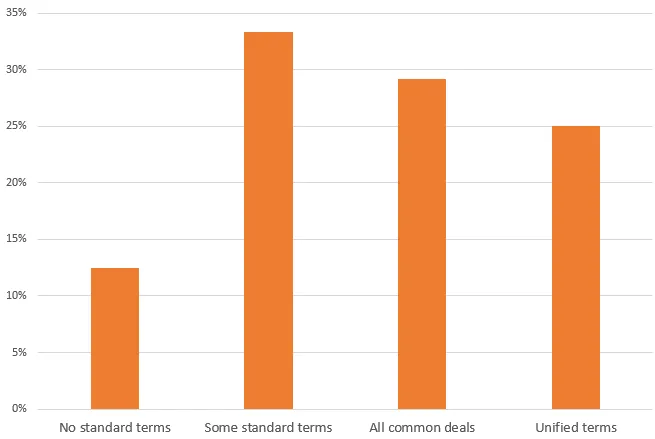
Pretty much every sizeable company now has at least some contract templates (their standard terms or precedents). But the extent to which common contracts have been standardised is mixed, as shown by the Radiant Scorecard.
So why does creating and improving templates matter?
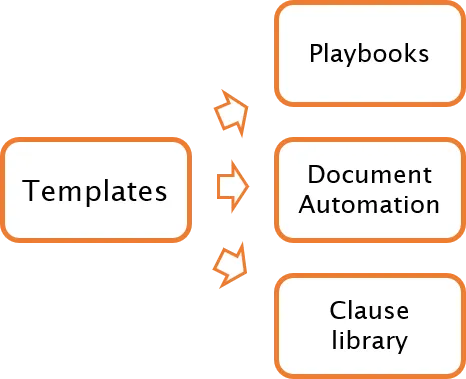
Templates have a leveraging effect. If they are good, you will see the impact across your contracting process, likewise if they are bad. Consistency through standard terms is better than inconsistency, unless you are consistently sending out terms with errors in them. The upshot is that time invested in improving your contract templates, quickly repays itself many times over.
How to improve the actual drafting of your templates is a huge topic. At Radiant, we have adopted A Manual of Style for Contract Drafting by Ken Adams.
MSCD is a highly opinionated book in an area where there are lots of opinions. The difference is that Ken brings an analytical rigour missing from most discussions. We are wary of heart-felt opinions handed down through the generations as “truth”, which started as some distant law firm partner’s personal preferences. Ken’s guidance is as close as we have to objectivity in this area and takes a no-nonsense, plain English approach. We recommend you adopt it too.
There are occasional examples of wildly unreasonable terms in consumer contracts leading to a public outcry (apparently some consumers read the small print). But beyond not opening up your company to ridicule, how reasonable should your drafts be?
First, your contract templates represent your company’s brand. They are a “moment of truth” showing how your business operates in practice with third parties. Your first draft will set the tone for the relationship.
Second, contracts engender an immediate emotional response when they are read. Negotiations are easier to close the more comfortable the two sides feel. A blatantly unfair draft will invoke hostility. Interestingly, the impression a contract gives is as much about the language as the underlying points. Your first draft will set the tone for the negotiation.
Third, contracts need to be entered into as fast as possible: there is a high cost to a protracted contracting process, including delaying cash flow for sales contracts and loss of agility for procurement contracts. Trying to get one-sided contracts into place with all your customers or suppliers needs to be balanced against the delays that this will cause. Your first draft will determine how fast you close your contracts.
Apart from mutual non-disclosure agreements, contracts are rarely symmetrical. Buyers and sellers have different concerns that will need to be addressed in the final version. The trick is to find a starting position that addresses both sides’ concerns at the outset of the negotiation.
We therefore recommend:
Overall, we believe you should be circulating a first contract draft that you would be willing to sign (even if it is not your ideal outcome) if you were on the other side.
Getting the right balance in templates is the responsibility of the GC (in consultation with the broader business). It takes bravery to start with more reasonable drafts. This needs to be lead from the top.
There is a common problem of trying to use a single generic template for many superficially similar but, in reality, different deals. In addition to requiring lots of customisation when issues arise that aren’t addressed in the generic template, the temptation is to keep adding additional points to the template. The outcome is large templates with irrelevant or inappropriate provisions for a particular deal. These will slow down negotiations significantly.
Including options in your templates will help, but there are limits to the number of changes that you can reasonably expect the drafter to manually make as they prepare a contract. As you increase the options, you increase the likelihood that the drafter will fall back on a previous deal, with all the risks of missing provisions and using pre-negotiated terms that this entails.
As a response, teams often create a number of different templates, with similar terms but addressing the specific needs of particular sub-types of deals (or different terms for different jurisdictions). The advantage is that the contracts are likely to be shorter and more relevant. The downside is that it becomes hard to keep the templates aligned as they evolve (we’ve worked with clients with hundreds of templates, making it a non-trivial problem).
We discuss below how to structure framework agreements so that specialist terms appear in separate optional modules. This will help, but the most powerful tool to solve this is document automation. We look at document automation in detail in this guide: you can produce shorter tailored first drafts in minutes, deal with a far greater range of options than you can with square brackets in Word documents, and ensure that different flavours of templates stay aligned as you update them.
Contract templates are typically the first stage in in-house teams making their contracting knowledge explicit, as the process forces you to take a position on all the relevant issues. Templates are typically created as a company builds out its in-house capabilities. As such, it is common for law firms to be asked to produce the first templates, although your mileage will vary over the quality of these templates (brand does not necessarily equate to quality when it comes to drafting). Don’t treat your terms as gospel just because of their source. What matters is that they are short, clear, relevant etc.
As you build out your internal expertise, creating templates often falls on the shoulders of a legal team member. If there is a perceived need to create consensus within the team, like a law of nature, the exercise always seems to take six months (or 18 months if it’s going to be used globally). The alternative is to bring in a third party, which may make sense when it comes to major exercises such as normalising large numbers of contract terms or drafting critical terms.
Whoever you use, we recommend:
Outside property, construction and finance, there are few examples of industry-standard terms. This state of affairs is inefficient and frustrating for business users. PLC and commercial contracts textbooks have tried to fill the gap, but the results are at best of mixed quality and relevance. So, you are typically faced with doing something between:
The latter is preferable, but we see a lot of copy and pasting and reuse of poor terms. Recognising that when wrangling a document into shape you are likely to be walking a fine line between order and chaos, here is an approach that we have found helpful:
Templates can become a valuable repository of knowledge about key risks and mitigators. They can also become sacred cows, full of provisions that no one dares change. We recommend a robust approach, keeping your templates under regular review and being prepared to delete, or at least shorten, just as often as you add.
Normalising templates
As you build out your library of templates, you will typically find that they have many different origins and are wildly inconsistent in how they are drafted and even the positions that they take. At some point you will want to normalise the provisions to the extent possible, giving you the ability to leverage improvements across templates, improve risk management and making it easier for your team to work with different templates.
The temptation with undertaking this exercise is to “compare all the templates with each other” to find all the points. This sounds reasonable, but is not a sensible approach in practice as these diagrams show. If you have 10 templates, you would need to do 45 comparisons between each of them. The better approach is to choose a “stake in the ground” - a good enough template to start with, and then review how it compares to other drafts - that’s 9 reviews, five times fewer.

Contract analytics
A great opportunity for contract improvements will come from looking at how your templates are working out in practice. Identifying clauses that are being over-negotiated, and points that are regularly raised and inevitably conceded, gives you opportunities to speed up negotiations.
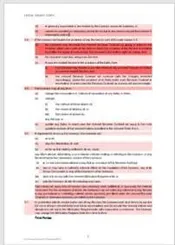
A regular review of your negotiated contracts will help you find these, but we’ve found that industrialising this process reaps large benefits and we’ve built a tool to compare, in one go, many tens of first markups v final versions, and show the results visually (as well as providing a detailed analysis to help identify points to include in the playbook). In this example, the darker the red, the more often the clause has been amended in the first draft. Reviewing the importance of the heavily negotiated clauses (do we need to take this position?) and the way they are worded (can we be less inflammatory?) is an excellent way to knock the edges off your templates.
The unfortunate nature of the contracting dance means that changes may still be made to your draft by the other side, however middle of the road it is. The trick is to get to the stage where the changes are random.
Despite the current AI hype, automated analytics of what positions have been taken in contracts are still at an early and crude stage. Fundamentally, you can find values in a contract (although it helps if you know where they will appear), you can track whether a particular clause has changed, and you can identify new clauses, but systems cannot yet interpret complex changes to language. The future is automated analytics and sophisticated risk modelling, but until we break out of document-centric contracting, tracking positions will usually require manual work.
Order Forms

To make your contracts as usable as possible, it makes sense to group the key variable terms (parties, commercials etc) in one place. For simple commercial agreements, we recommend putting these up front, with the terms behind. This makes management of the agreement far easier and puts the focus on the most important provisions.
Schedules can be used, but we recommend caution. They can become the place to abandon terms that don’t necessarily fit well with the rest of the agreement and, especially with security schedules, have an unfortunate habit of exploding with unreasonable and overly-broad positions.
Frameworks
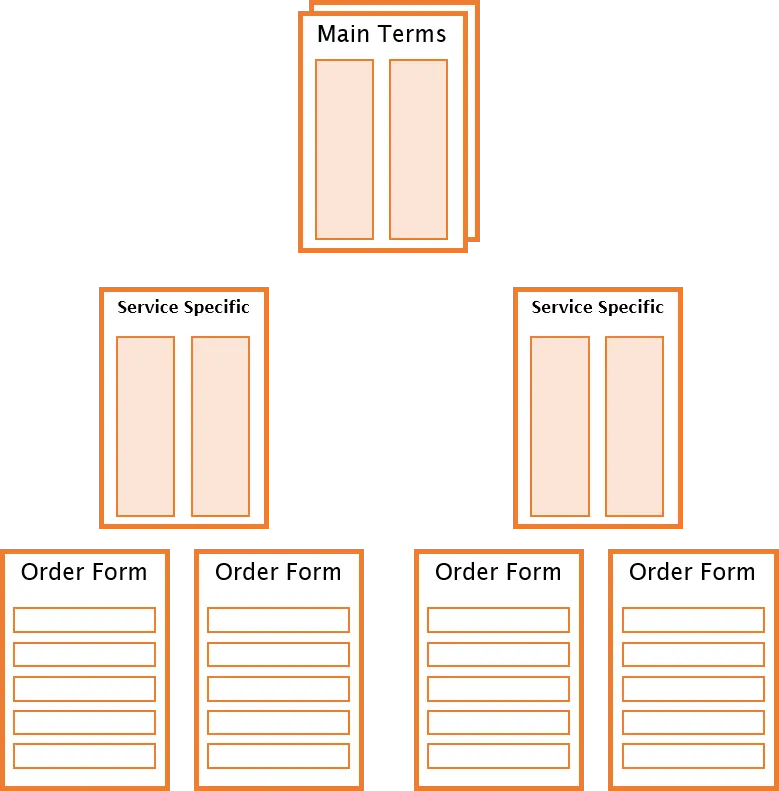
Moving beyond simple agreements, there is a distinct advantage to creating a relationship that can be expanded over time with your customers and major suppliers. The standard way of approaching this is with a framework agreement that lets you add new products and services with minimal negotiation.
A problem with this approach is how to deal with terms that apply to some, but not all, products. Including them in order forms can lead to repetition and the re-opening of issues ideally addressed only once. One approach that works well is to split the agreement into three levels - core terms, service-specific terms and then use an order form as above.
Schedules and complex agreements
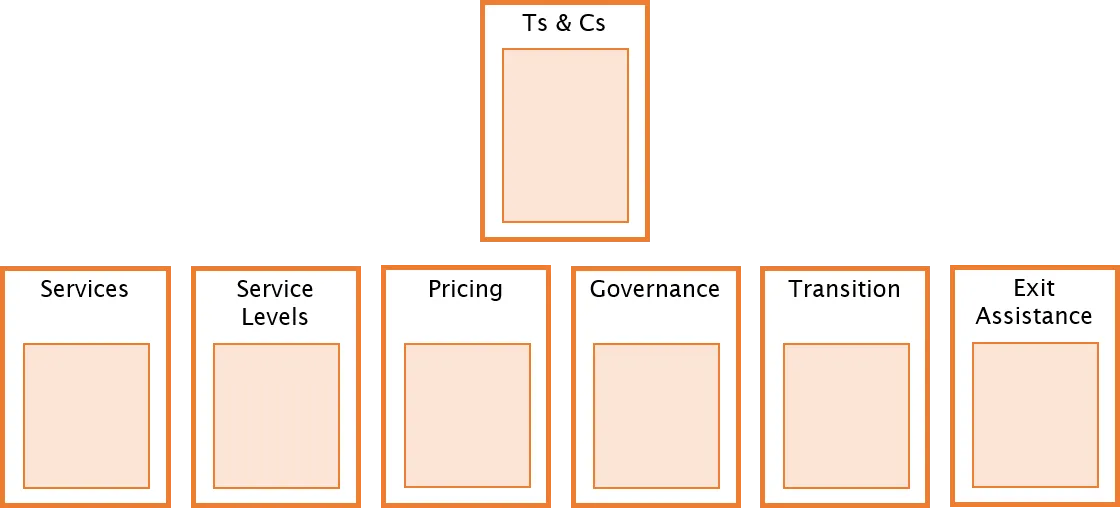
For large and complex transactions, schedules become inevitable. There is a balancing act as you decide where to locate the different topics in the agreement. If you aren’t careful, the schedules can become dumping grounds for lists, and terms relating to the same topic can be scattered throughout your agreement, making the negotiations and consistency far harder than they need to be.
We recommend using the schedules to organise the key parts of the contract and limiting the main terms to the more legalistic provisions (following principles in programming of Separation of Concerns and Don’t Repeat Yourself or “DRY”).
Local Agreements
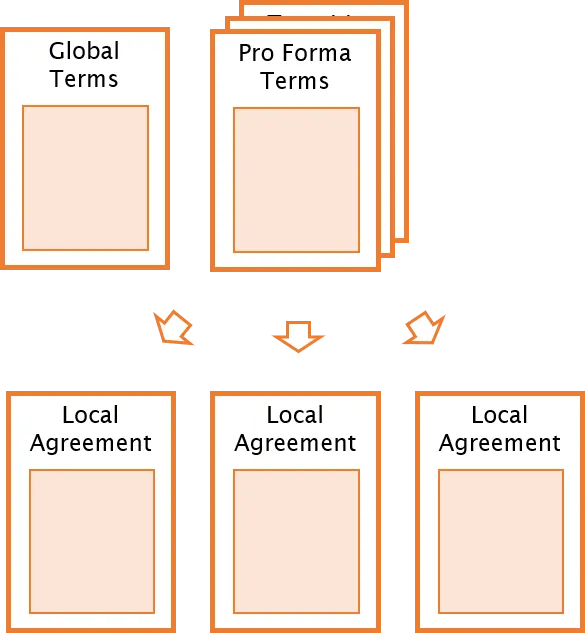
A structuring issue that comes up with multinational agreements is the need for local agreements to address issues such as permanent establishment. Your chosen structure will need to address the following:
Having seen many approaches, our preference is to have:
Diagrams
There has been some recent interest in using visuals in contracts to make them more useable. This design-led movement has been primarily academic and although there have been some interesting examples in consumer contracts, there has been little uptake to date with commercial contracts.
The idea of making contracts clearer and more accessible is attractive, and we are interested to see more examples in actual usage. It is not clear yet whether diagrams will dramatically help or the extent that they can cover parts of the contract beyond timelines.
Styles are pre-set formatting in Word - i.e., if you apply a style to a paragraph, it will sort out all the formatting. The only way to maintain your sanity with Word is to use styles rather than fighting them. If you fight them, then you will spend a large amount of time messing around with formatting, which is rarely fun.
Your templates should be properly styled using a Word Styles Template. You should use the same styles template for all your contracts. You will then know that your contracts are at least set up correctly when your users start using them.
Unfortunately, although Word wants you to use styles, it also offers lots of opportunities to break your styles. For example, text copied from another document can import unwanted styles (or corrupt your styles) if not done carefully. Luckily, if you have set up your contracts correctly at the beginning then, even if they are messed up by the other side, you can easily fix them again later - this is now a solved problem.
It would be a lot easier if it took one to tango, but contracts have two sides. The temptation is to go into broadcast mode and send PDFs rather than Word versions to the other side. This can work in reducing the number of comments, but is prone to frustrate, if not anger, the other side and can lead to unhelpful responses such as scanned manual mark-ups or the document being converted into a broken Word version and then marked up with track changes. An alternative we have seen is to lock Word documents so that track changes are mandatory and formatting changes are limited, although getting the options right is important to not frustrate the other side.
We have seen organisations negotiate changes using a separate document, which overrides the standard terms. This approach can help highlight the differences to the standard terms and may reduce the number of changes, although it makes the contract less usable. Generally though market norms are to send a Word version and sending just PDFs rarely works if you don’t have a strong negotiating position.
It can feel like dragged out negotiations are inevitable. The reality is that the quality of the first draft is the biggest factor determining how fast you close your contracts. Be brave and ruthless in improving your contract templates.
You might be wondering what your next steps should be. Let us guide you with three easy options:

We use cookies to monitor the performance of our website and to improve user experience. By continuing to browse our site, you agree to our use of cookies.