
How we simplified complex contracts across multiple business areas
The situation
A large international bank was dealing with a familiar contracting problem at scale: templates had become complex, inconsistent and difficult to use.
Across different business areas, teams were working with contracts that counterparties found too complicated, plus internal positions and fallback options were not always clear. Additionally, knowledge was decentralised, and people sometimes had to ask colleagues the same questions more than once.
What we found
Producing a contract from a template could take between one and three hours. Negotiations could take longer than necessary because teams were unsure when to escalate an issue or what fallback position to use. In some areas, contract wording was inconsistent; in others, templates were hard to find, difficult to interact with or simply not intuitive.
The international dimension made the problem harder. One business area was trying to harmonise terms and contractual structures across 16 jurisdictions, while still accounting for local legal requirements, services and operational constraints.
The bank wanted to simplify the client experience, improve consistency and reduce unnecessary effort without stripping out the substance the contracts needed.
There was also a knowledge-management problem to solve. Negotiating positions often sat with individuals rather than in a reusable system, increasing the risk of unnecessary escalation and inconsistent decision-making.
What we built
We worked with the bank across four identified business areas, focusing on rewriting documents and understanding why the existing templates were creating friction.
The work combined document simplification with negotiation guidance and more structured knowledge capture and included:
- Reviewing frequently used and heavily negotiated templates;
- Identifying the root causes behind drafting and negotiation problems;
- Simplifying language and reducing unnecessary wording;
- Removing overlapping or conflicting terms;
- Standardising clauses and capturing them in a clause database;
- Creating or improving playbooks with acceptable fallback positions;
- Producing drafting and negotiation reference guides;
- Documenting sources and key decisions in annotated versions of templates; and
- Exploring technology that could make drafting, negotiation and signing faster.
Implementation was collaborative rather than a one-off document handover. Weekly project calls gave the bank visibility over progress, while additional calls with individual template owners were used to work through proposed changes.
The difference it made
The clearest improvements came from reducing the amount of material users had to navigate while making negotiation guidance easier to access.
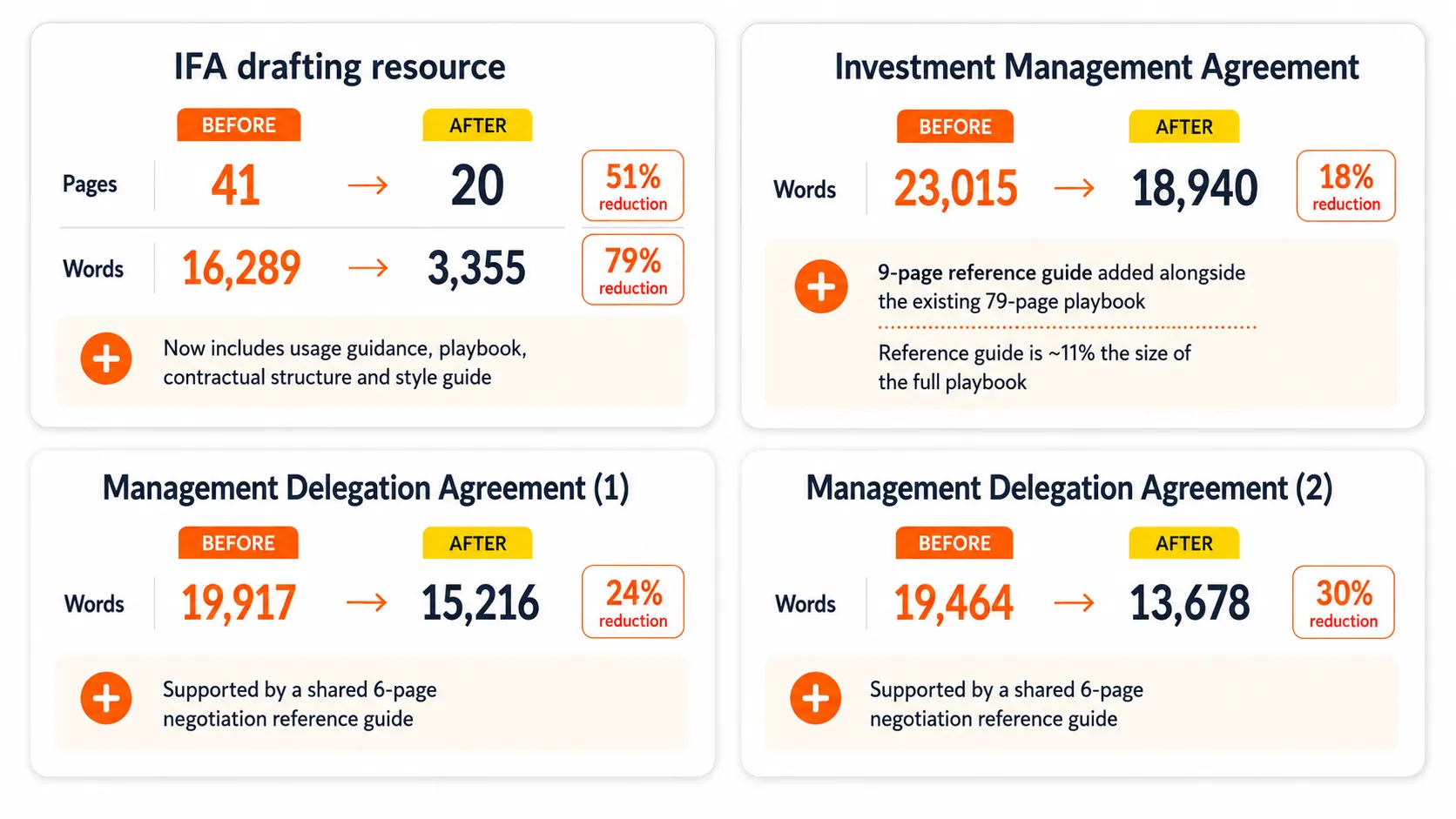
Not every document became dramatically shorter. The International Framework Agreement itself, (standalone from the supporting IFA drafting resource), remained at 32 pages because it absorbed commercial terms that had previously sat elsewhere. The objective was not to cut pages for the sake of it, but to make the overall contracting system clearer and easier to use.
At the end of the project the bank had:
- Revised and annotated agreements showing drafting history and key decisions;
- Playbooks containing commonly negotiated provisions and fallback positions;
- A standard clause database;
- A drafting style guide; and
- Shorter reference materials for several complex agreements.
Feedback from the participating teams was consistently positive.
Legal specifically reported that optimising contracts “saves time in both drafting and negotiating.” Negotiations became more efficient, with improved customer experience and lower client-management costs.
The cross-border business team described the work as a “first major achievement” that had given it a contractual framework it could already take back to the business while preparing for further discussions across the 16 countries involved.
Talk to Radiant about managed legal services, contract projects or specialist support for your team.


We use cookies to monitor the performance of our website and to improve user experience. By continuing to browse our site, you agree to our use of cookies.
