

The situation
Following the publication of the EBA and PRA guidelines on outsourcing arrangements, one of the world’s largest banking and financial services institutions needed to update its outsourcing agreements to support regulatory compliance.
The requirement itself was clear. The challenge was how to get the work done at the pace, quality and scale required.
What we found
The original proposed approach would have treated every supplier in broadly the same way: a bespoke review and amendment for each agreement. While thorough, it risked making the project slower, more expensive and harder to manage because the supplier population was not uniform.
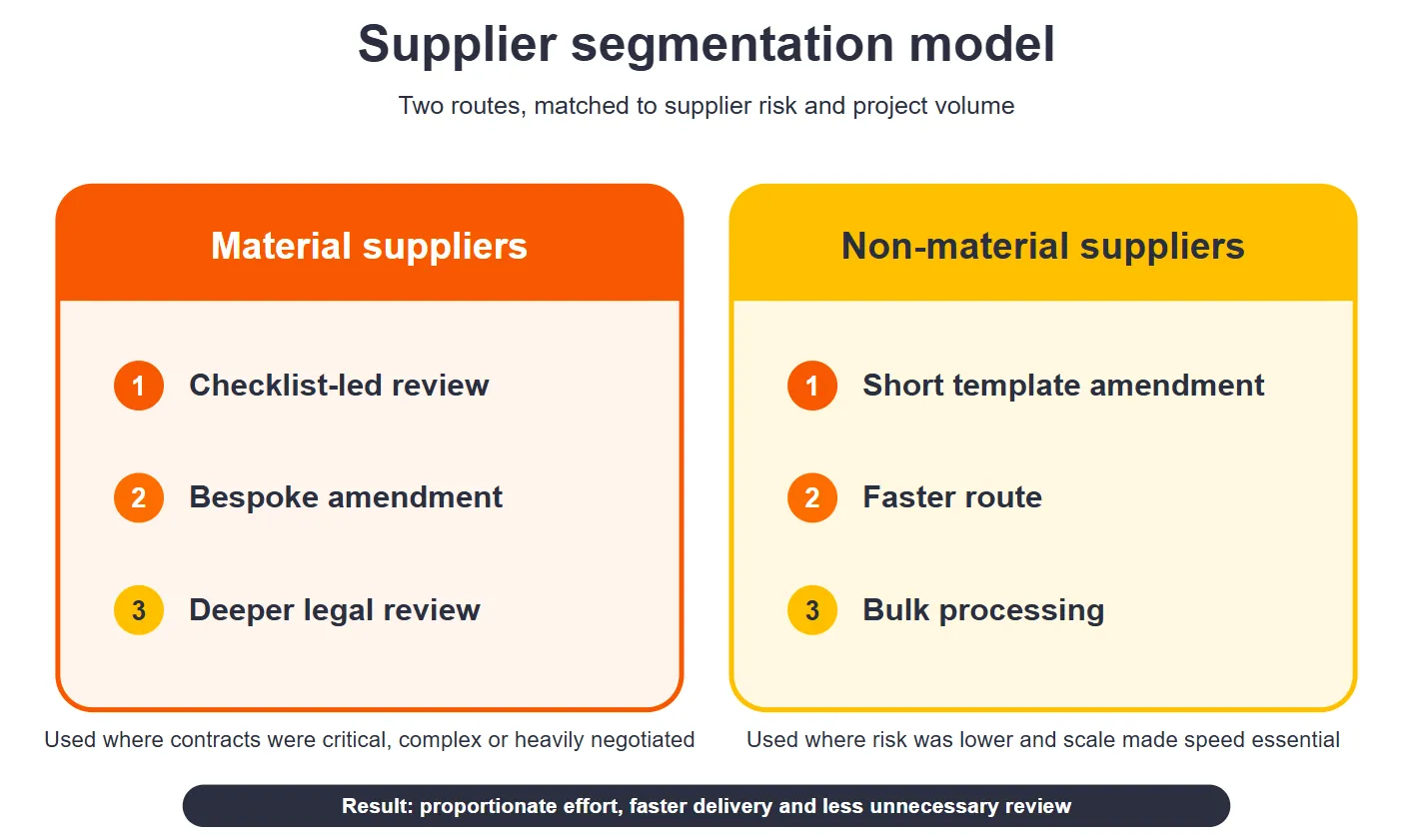
Some suppliers were classified as material, meaning that agreements would be subject to more stringent regulatory requirements, while other suppliers were classified as non-material and did not require the same level of remediation and bespoke amendment.
Applying one intensive process across all suppliers would have created avoidable friction:
- More legal review than was needed for lower-risk agreements
- More time spent producing bespoke amendments
- Greater pressure on internal Legal and Procurement teams
- A higher project cost
- Increased risk of missing the regulatory deadline
The bank needed a better operating model for the work at hand.
What we built
We proposed a differentiated remediation approach that separated material and non-material suppliers.
The aim was to keep the work proportionate: apply deeper legal review where it was genuinely needed, and use a more streamlined process where the risk profile allowed it.
Governance and project control
Alongside the contract process, we worked closely with the client’s Procurement and Legal teams to manage governance, resolve ad hoc issues and keep the project moving.
We built the practical tools needed to run the work consistently, including:
- process maps for different supplier categories
- templates for each route
- playbooks to guide review and decision-making
- checklists to support consistency and quality control
- data outputs to track progress and capture learnings
The approach was flexible by design. It gave the client enough structure to manage scale, but enough room to make judgement calls where the supplier relationship or contract history required it.
The difference it made
“You present solutions we hadn’t thought of”
“The trust is there. We have built it up over time through your performance on different projects. You are able to educate us so our contract review and remediation projects are as efficient as possible. You come to us and present solutions that we hadn’t thought of, different ways to achieve a good result that we wouldn’t have even considered. I love the flexibility of your approach.”
Legal Project Manager
The redesigned approach helped the bank complete the remediation work on time and for a fixed price.
Instead of treating every contract as a bespoke legal exercise, they could focus effort where it mattered most. Material suppliers received the deeper review they needed. Non-material suppliers moved through a faster, more proportionate route.
That meant the project could be launched and closed sooner than the original approach would have allowed.
It also reduced pressure on the client’s internal teams. Legal and Procurement were not burdened by unnecessary review work across the entire supplier base. They could focus their time on the areas where judgement, escalation and stakeholder management were most valuable.
By the end of the project, the client also had useful data insights and lessons learned to improve future remediation projects.
Why this mattered for transformation
For organisations facing regulatory, commercial or operational change, the default response is often to add capacity - more reviewers, more effort and more hours.
This project showed the value of stepping back before scaling up.
The biggest gain came from changing the design of the work. By separating suppliers by risk and materiality, the client avoided a one-size-fits-all process that would have slowed the project down and increased cost.
That is where project-led legal support can make a broader organisational difference: not just completing a task, but helping the business work in a more efficient, repeatable and commercially sensible way.
Talk to Radiant about managed legal services, contract projects or specialist support for your team.


We use cookies to monitor the performance of our website and to improve user experience. By continuing to browse our site, you agree to our use of cookies.
